
How to Build Safe, Effective Yoga Sequences for Any Level
Picture this: You’re standing at the front of a yoga class, looking out at a sea of expectant faces—some eager beginners, others seasoned practitioners, and a few who look like they’d rather be anywhere else. Your heart races as you realize you need to create a sequence that challenges the advanced students while keeping the newcomers safe and engaged. Sound familiar? Whether you’re a yoga teacher or simply someone who wants to deepen their personal practice, mastering the art of yoga sequencing is like learning to conduct a beautiful symphony of movement, breath, and intention.
Key Takeaways
- Safety First: Proper sequencing prioritizes joint preparation and gradual warm-up before challenging poses
- Universal Principles: Effective sequences follow a natural arc from grounding to peak poses to integration
- Adaptability: Great sequencing accommodates all levels through modifications and variations
- Intentional Flow: Each pose should logically prepare the body for the next, creating smooth transitions
- Balance: Well-rounded sequences address all major muscle groups and movement patterns
Understanding the Foundation of Yoga Sequencing
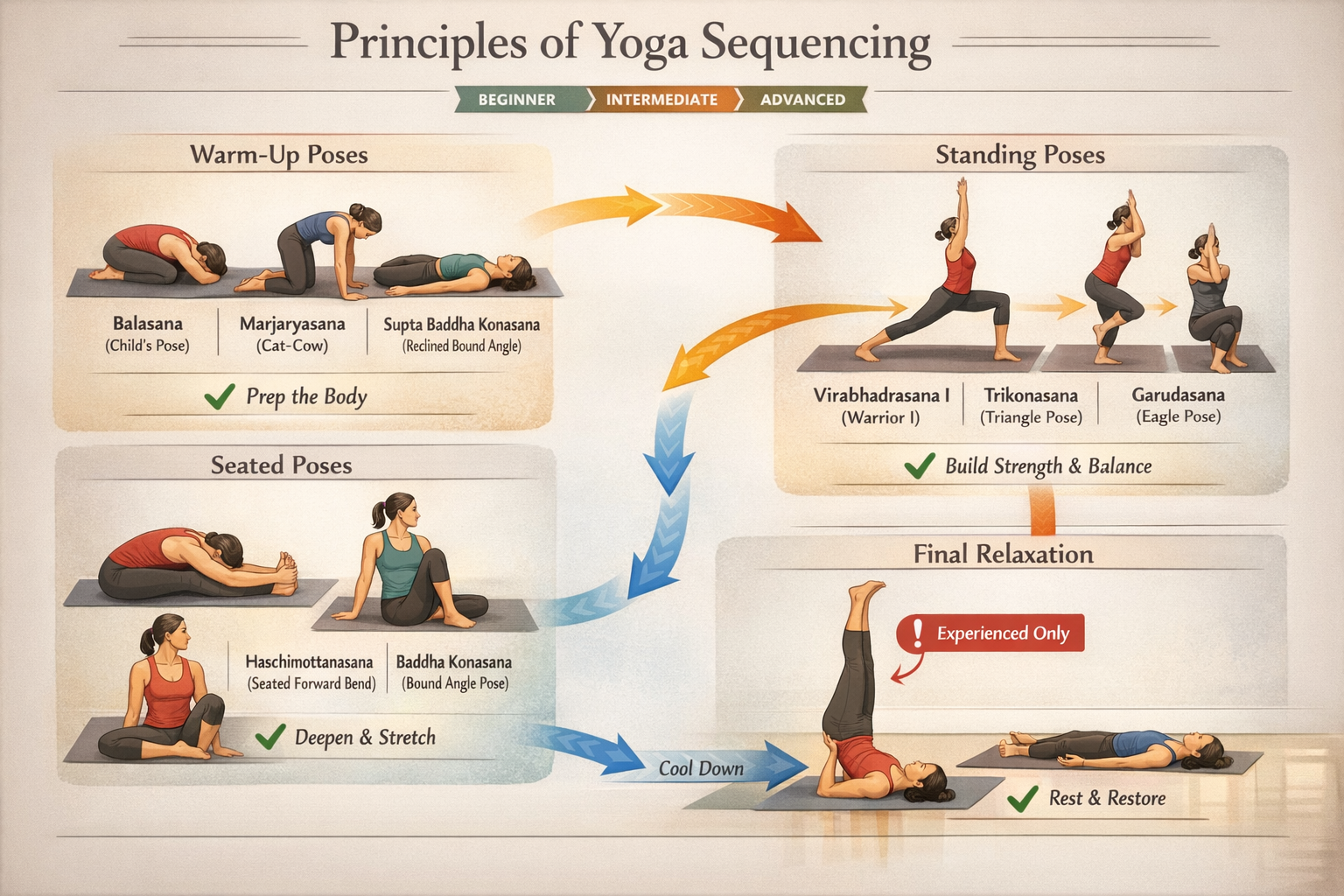
When I first started teaching yoga, I thought sequencing was simply stringing together poses that looked good. Boy, was I wrong! Yoga sequencing is actually a sophisticated art form rooted in ancient wisdom and modern biomechanics. It’s about creating a journey that honors the body’s natural movement patterns while supporting students’ physical and emotional well-being.
The foundation of effective sequencing lies in understanding that our bodies need preparation before they can safely access deeper poses. Think of it like warming up your car on a cold morning—you wouldn’t rev the engine immediately, right? Similarly, our joints, muscles, and nervous system require gentle awakening before we ask them to perform complex movements.
At Yoga4.biz, we’ve seen countless teachers transform their classes simply by applying these fundamental sequencing principles. The magic happens when you understand that each pose serves a purpose beyond just “looking yogic.”
The Anatomy of Movement Patterns
Before diving into specific sequences, it’s crucial to understand the six primary movement patterns of the spine:
- Flexion (forward bending)
- Extension (backbending)
- Lateral flexion (side bending)
- Rotation (twisting)
- Axial extension (lengthening)
- Neutral (maintaining natural curves)
A well-rounded yoga sequence addresses all these patterns, ensuring balanced development and reducing the risk of injury. This is where the science meets the art—understanding biomechanics allows us to create sequences that feel intuitive while being anatomically sound.
The Universal Sequence Template: Your Roadmap to Success
Every effective yoga sequence, regardless of style or duration, follows a similar arc. I like to think of it as the hero’s journey of yoga practice—we begin in our ordinary world, venture into challenge and transformation, then return home changed.
Phase 1: Grounding and Centering (5-10% of class time)
This opening phase is like setting the stage for a theatrical performance. We’re not just warming up the body; we’re transitioning from the external world into the sacred space of practice. Common elements include:
- Breath awareness 🫁
- Intention setting
- Gentle movement to awaken proprioception
- Meditation or mindfulness practices
For beginners, this might be as simple as sitting comfortably and taking three deep breaths. For advanced practitioners, you might include pranayama techniques or longer meditation periods.
Phase 2: Warming and Mobilizing (15-20% of class time)
This is where we literally warm up the body, increasing circulation and preparing joints for more demanding movements. The key is progressive loading—gradually increasing range of motion and intensity.
Essential warm-up movements include:
- Cat-cow stretches for spinal mobility
- Gentle twists to awaken the core
- Shoulder rolls and arm circles
- Hip circles and gentle leg swings
Remember, warming up isn’t just physical—it’s also neurological. We’re essentially telling our nervous system, “Hey, we’re about to move in some interesting ways, so please pay attention!”
Phase 3: Sun Salutations or Standing Flow (20-25% of class time)
This phase bridges the gap between gentle warm-up and the more challenging portions of practice. Sun salutations (Surya Namaskara) are brilliant because they systematically move the spine through multiple planes of motion while building heat and focus.
For those new to yoga’s transformative power, this phase might feel challenging initially. That’s perfectly normal! The beauty of good sequencing is that it meets students where they are while gently encouraging growth.
Phase 4: Standing Poses (15-25% of class time)
Standing poses are the workhorses of yoga practice. They build strength, stability, and confidence while teaching fundamental alignment principles that apply to more advanced poses later.
Key standing pose categories:
- Grounding poses (Mountain, Chair)
- Forward folds (Standing forward fold, Wide-legged forward fold)
- Balancing poses (Tree, Warrior III)
- Lateral poses (Triangle, Extended side angle)
The secret to sequencing standing poses effectively is understanding their energetic qualities. Grounding poses should come first, followed by more dynamic movements, with balancing poses typically placed when students are warm but not yet fatigued.
Phase 5: Peak Poses (10-20% of class time)
This is the climax of your sequence—the pose or poses that everything else has been building toward. Peak poses are typically the most challenging or advanced postures in your sequence, requiring the greatest amount of preparation.
Popular peak pose categories:
- Backbends (Camel, Wheel, Scorpion)
- Hip openers (Pigeon, Lotus variations)
- Arm balances (Crow, Side crow, Firefly)
- Inversions (Headstand, Forearm stand)
The art of peak pose sequencing lies in the preparation. Every pose leading up to your peak should systematically prepare the body for the demands of that posture. It’s like assembling a puzzle—each piece must fit perfectly to create the complete picture.
Phase 6: Seated Poses and Floor Work (15-20% of class time)
After the intensity of peak poses, we begin the journey back to stillness. Seated poses allow for deeper introspection while continuing to work with flexibility and gentle strengthening.
This phase often includes:
- Seated forward folds for calming the nervous system
- Gentle twists for spinal health and digestion
- Hip openers for releasing stored tension
- Gentle backbends if needed for balance
Phase 7: Relaxation and Integration (10-15% of class time)
The final phase is arguably the most important—it’s where the magic of transformation actually occurs. Savasana (Corpse pose) isn’t just lying down; it’s an active practice of integration where the body assimilates all the work we’ve done.
This phase might include:
- Gentle restorative poses
- Breathing practices
- Meditation
- Final relaxation
🧘♀️ Yoga Sequence Builder
Create a personalized yoga sequence based on your preferences
Adapting Sequences for Different Levels
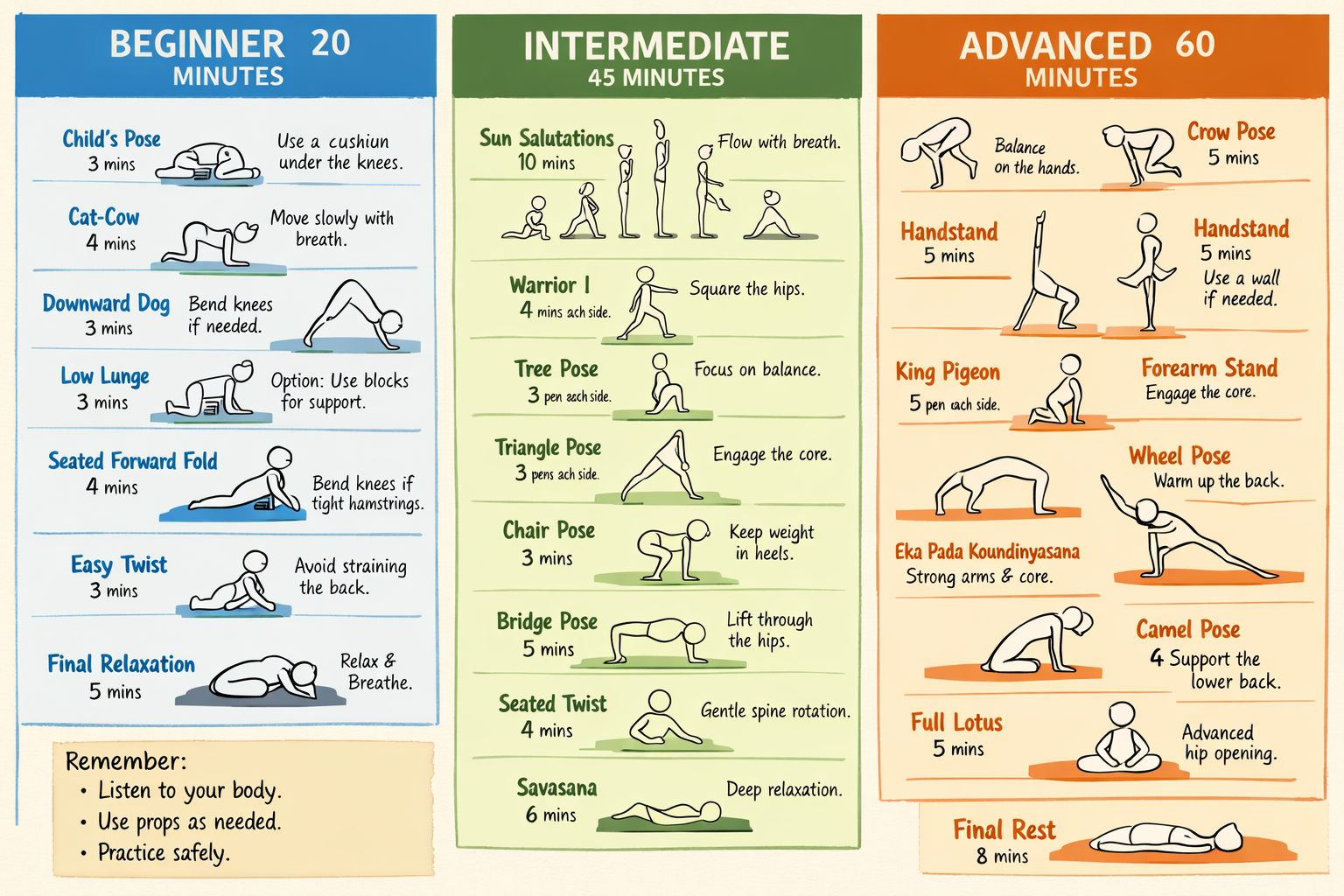
One of the biggest challenges in yoga sequencing is creating classes that serve multiple levels simultaneously. The secret isn’t to dumb everything down to the lowest common denominator—it’s to layer your instruction and provide clear options for everyone.
Beginner-Friendly Sequencing Strategies
When working with beginners, remember that everything is new. What seems obvious to experienced practitioners can be completely foreign to someone stepping onto a yoga mat for the first time. Here are key principles for beginner sequences:
🔑 Keep it simple: Focus on fundamental poses and clear alignment cues rather than fancy transitions or advanced variations.
🔑 Repeat patterns: Use the same sequence multiple times so students can build familiarity and confidence.
🔑 Emphasize breath: Constantly remind students to breathe—it’s easy to forget when concentrating on new movements!
🔑 Provide props: Blocks, straps, and bolsters aren’t crutches—they’re tools that make poses accessible and safe.
A typical beginner sequence might repeat the same standing sequence 2-3 times, allowing students to refine their alignment and build strength gradually. This repetition also builds confidence, which is just as important as physical preparation.
Intermediate Sequencing: Building Complexity
Intermediate students have developed basic strength and flexibility but are ready for more challenge and variety. This is where sequencing becomes really fun! You can start introducing:
- More complex transitions
- Longer holds
- Variations of familiar poses
- Introduction to peak poses
- Arm balances and inversions
The key with intermediate students is to challenge them while maintaining the safety principles they’ve learned. It’s like learning to drive—they know the basics, but now they’re ready for highway speeds and parallel parking!
Advanced Sequencing: Refinement and Mastery
Advanced practitioners don’t just need harder poses—they need more sophisticated sequencing that challenges them in subtle ways. This might include:
- Complex transition sequences
- Advanced breathing techniques
- Longer meditation periods
- Energetic refinement
- Teaching opportunities within class
Advanced sequencing is less about physical challenge and more about depth of practice. These students are often working on the subtler aspects of yoga—energy management, mental focus, and spiritual development.
Common Sequencing Mistakes and How to Avoid Them
Even experienced teachers fall into sequencing traps. Let me share some of the most common mistakes I’ve seen (and made myself!) over the years:
Mistake #1: Jumping into Peak Poses Too Quickly
The Problem: Going straight into challenging poses without adequate preparation is like trying to run a marathon without training—injury is almost inevitable.
The Solution: Map out your peak pose requirements and work backward. If you’re teaching Wheel pose, students need open shoulders, flexible spine, strong legs, and warm wrists. Every pose leading up should address at least one of these requirements.
Mistake #2: Ignoring the Nervous System
The Problem: Treating yoga like a purely physical practice ignores the profound effects on our nervous system. Jumping between high-energy and low-energy poses without consideration can leave students feeling scattered.
The Solution: Understand the energetic qualities of poses. Generally, move from grounding to energizing to calming. If you need to include an energizing pose late in class, follow it with adequate cooling poses.
Mistake #3: One-Size-Fits-All Mentality
The Problem: Teaching the same sequence to every class regardless of student needs, time of day, or season.
The Solution: Learn to read your room. A 6 AM class needs different energy than a 7 PM class. Monday classes might need more gentle opening after the weekend, while Friday classes might need stress relief.
Mistake #4: Neglecting Counterposing
The Problem: Failing to balance intense poses with appropriate counter-poses can create imbalances and discomfort.
The Solution: Learn the basic counter-pose relationships:
- Forward folds counter backbends
- Twists counter lateral poses
- Gentle movements counter intense holds
Building Theme-Based Sequences
One of the most effective ways to create memorable and meaningful classes is through thematic sequencing. This approach goes beyond just physical preparation to create a cohesive experience that resonates on multiple levels.
Seasonal Sequencing
Our bodies naturally respond to seasonal changes, and our yoga practice can honor these rhythms:
🌸 Spring Sequences: Focus on renewal, detoxification, and gentle awakening. Emphasize twists, hip openers, and heart-opening poses.
☀️ Summer Sequences: Embrace dynamic flow, strength-building, and cooling practices. Include sun salutations, standing poses, and cooling pranayama.
🍂 Autumn Sequences: Cultivate grounding, balance, and letting go. Focus on standing poses, gentle backbends, and restorative practices.
❄️ Winter Sequences: Emphasize introspection, warmth-building, and conservation of energy. Include longer holds, gentle flows, and extended relaxation.
Chakra-Based Sequencing
Working with the chakra system provides a beautiful framework for creating energetically coherent sequences. Each chakra corresponds to specific physical areas, emotional themes, and types of poses:
- Root Chakra: Standing poses, grounding practices
- Sacral Chakra: Hip openers, creative flows
- Solar Plexus: Core strengthening, twists
- Heart Chakra: Backbends, arm opening
- Throat Chakra: Neck releases, chanting
- Third Eye: Balancing poses, meditation
- Crown Chakra: Inversions, spiritual practices
Anatomical Focus Sequences
Sometimes the most effective approach is to focus on specific areas of the body that need attention. This is particularly useful for therapeutic applications or when working with students who have specific needs.
Hip-Opening Sequences might progress from gentle warm-ups like hip circles to standing poses like Warrior II, then to deeper seated openers like Pigeon, and finally to restorative hip releases.
Heart-Opening Sequences require extensive preparation of the shoulders, spine, and hip flexors before accessing deeper backbends. The journey from simple chest expansion to full Wheel pose might take an entire class—or several classes!
The Art of Transitions: Creating Flow
Great sequencing isn’t just about choosing the right poses—it’s about how you connect them. Smooth transitions are what transform a series of poses into a flowing practice that feels like a moving meditation.
Biomechanical Transitions
The most important aspect of transitions is biomechanical efficiency. Each transition should feel natural and prepare the body for what’s coming next. Some principles to keep in mind:
- Use gravity wisely: Moving from standing to seated should feel like a natural descent, not a jarring drop
- Maintain spinal integrity: Avoid transitions that require the spine to move through multiple planes simultaneously
- Prepare joints gradually: Don’t ask cold joints to move through their full range immediately
Energetic Transitions
Beyond the physical, transitions also manage the energetic flow of practice. A well-sequenced class has an energetic arc that supports the overall intention:
- Building energy: Use dynamic movements and challenging poses
- Sustaining energy: Maintain consistent effort and focus
- Releasing energy: Gradually slow down and simplify movements
Breath-Based Transitions
In vinyasa-style classes, the breath becomes the metronome that guides transitions. One breath, one movement creates a meditative quality that transforms physical practice into moving meditation. However, this doesn’t mean every transition needs to be breath-synchronized—sometimes allowing natural breathing rhythms is more appropriate.
Modifications and Variations: Making Yoga Accessible
A truly skillful sequence provides multiple entry points for every pose, ensuring that all students can participate meaningfully regardless of their physical limitations or experience level.
The Three-Tier System
I like to think of modifications in three tiers:
Tier 1: Accessible Version – This is the most supported, gentle version of the pose that allows students to experience the essential elements without strain.
Tier 2: Classical Version – This is the “standard” expression of the pose that most students will work toward.
Tier 3: Challenge Version – This offers additional complexity or intensity for students who need more challenge.
For example, with Triangle Pose:
- Tier 1: Hand on shin or block, bent front knee if needed
- Tier 2: Hand on floor or ankle, straight legs
- Tier 3: Bind underneath front leg, or transition to revolved triangle
Using Props Effectively
Props aren’t just for beginners—they’re tools that can make poses more accessible, more challenging, or simply different. Understanding how to sequence with props opens up infinite possibilities:
- Blocks can bring the floor closer or add challenge to balancing poses
- Straps can extend reach or provide resistance
- Bolsters can support restorative poses or make seated poses more comfortable
- Walls can provide support for inversions or assistance with alignment
Special Populations: Adapting Your Sequences
As yoga becomes more mainstream, we’re seeing increasing diversity in our classes. Learning to adapt sequences for different populations is essential for inclusive teaching.
Prenatal Sequencing
Pregnant students require significant modifications, particularly avoiding:
- Deep twists (especially closed twists)
- Prone positions after the first trimester
- Deep backbends that stretch the already-stressed abdominal muscles
- Hot environments or intense heat-building sequences
Instead, focus on:
- Hip openers to prepare for birth
- Gentle strengthening to support the changing body
- Stress relief and relaxation techniques
- Breathing practices that can be used during labor
Senior Sequencing
Older students bring wisdom and often decades of body awareness, but may need accommodations for joint health and balance concerns:
- Chair-supported poses for balance challenges
- Longer warm-ups as joints may need more preparation
- Gentle strengthening to maintain bone density
- Balance challenges to prevent falls
- Restorative elements for nervous system support
Trauma-Informed Sequencing
Creating safe spaces for students with trauma histories requires sensitivity in sequencing:
- Predictable structure reduces anxiety
- Choice and agency in pose variations
- Avoiding forceful adjustments or intense hip openers without warning
- Keeping eyes open options during meditation
- Clear entry and exit instructions for poses
For more insights on yoga’s holistic approach to wellness, understanding these adaptations becomes crucial for creating truly inclusive spaces.
Advanced Sequencing Concepts
Once you’ve mastered the basics, there are more sophisticated concepts that can elevate your sequencing to an art form.
Energetic Sequencing
This approach considers not just the physical effects of poses but their energetic qualities:
- Grounding poses (standing poses, forward folds) calm and center
- Heating poses (sun salutations, standing flows) energize and focus
- Opening poses (backbends, hip openers) create expansion and vulnerability
- Integrating poses (twists, gentle movements) help process and balance
Seasonal and Circadian Rhythms
Advanced sequencing considers natural rhythms:
Morning sequences might emphasize:
- Gentle awakening movements
- Energizing sun salutations
- Standing poses for grounding and focus
- Minimal relaxation (save energy for the day)
Evening sequences might include:
- Stress-releasing movements
- Hip openers for emotional release
- Gentle backbends to counter forward-hunched posture
- Extended relaxation for nervous system restoration
Therapeutic Sequencing
This approach uses yoga specifically to address physical or emotional imbalances:
- Anxiety sequences might emphasize grounding poses, longer exhales, and restorative positions
- Depression sequences might include gentle backbends, energizing movements, and practices that cultivate self-compassion
- Back pain sequences might focus on strengthening weak muscles while gently stretching tight ones
Technology and Sequencing
Modern technology offers incredible tools for sequence planning and sharing. Whether you’re documenting your sequences for future use or sharing them with students, digital tools can enhance your teaching:
Sequence Planning Apps
Several apps allow you to:
- Build visual sequences with pose illustrations
- Time sequences for different class lengths
- Share sequences with students
- Track which sequences work best for different populations
Online Resources
Platforms like our blog provide ongoing inspiration and education for sequence development. The yoga community is incredibly generous with sharing knowledge and experience.
Building Your Sequencing Toolkit
Developing strong sequencing skills takes time and practice. Here are some strategies to accelerate your learning:
Study Anatomy
Understanding how the body works will make your sequencing infinitely more effective. You don’t need a medical degree, but basic knowledge of:
- Major muscle groups and how they work together
- Joint mechanics and range of motion
- Nervous system responses to different types of movement
Practice Different Styles
Each yoga tradition offers unique insights into sequencing:
- Ashtanga teaches the power of repetition and systematic progression
- Iyengar emphasizes precise alignment and therapeutic applications
- Vinyasa explores creative flow and breath synchronization
- Yin demonstrates the profound effects of longer holds and passive stretching
Observe Master Teachers
Watch how experienced teachers structure their classes. Notice:
- How they prepare students for challenging poses
- Their use of repetition and variation
- How they manage energy throughout the class
- Their modification strategies
Keep a Sequencing Journal
Document your sequences and their effects:
- What worked well?
- What felt awkward or unsafe?
- How did students respond?
- What would you change next time?
The Future of Yoga Sequencing
As our understanding of movement science, neuroscience, and trauma-informed practices evolves, so does our approach to sequencing. Some emerging trends include:
Individualized Sequencing
Technology may soon allow for real-time biometric feedback to customize sequences for individual students’ needs in the moment.
Integration with Other Modalities
Sequencing that incorporates elements from:
- Physical therapy for rehabilitation
- Mindfulness-based stress reduction for mental health
- Somatic practices for nervous system regulation
- Ayurveda for constitutional balancing
Cultural Sensitivity and Decolonization
Growing awareness of yoga’s cultural origins is influencing how we approach sequencing, with greater emphasis on:
- Honoring traditional teachings while adapting for modern needs
- Inclusive language that doesn’t appropriate Sanskrit unnecessarily
- Diverse teaching voices bringing different perspectives to sequencing
Conclusion
Mastering yoga sequencing is like learning to speak a beautiful, complex language—one that communicates through movement, breath, and intention rather than words. The principles we’ve explored in this comprehensive guide provide the grammar and vocabulary, but the real magic happens when you begin to develop your own voice as a sequence creator.
Remember that great sequencing serves the students in front of you, not your ego or desire to teach fancy poses. Whether you’re planning a gentle restorative class or an advanced arm balance workshop, the same fundamental principles apply: safety first, logical progression, and mindful attention to the whole person—body, mind, and spirit.
As you continue developing your sequencing skills, be patient with yourself. Like any art form, mastery comes through consistent practice, thoughtful observation, and willingness to learn from both successes and mistakes. Every class you teach, every sequence you create, is an opportunity to refine your understanding and deepen your service to the yoga community.
Your Next Steps
- Start small: Choose one sequencing principle from this guide and focus on implementing it in your next class
- Practice regularly: The best way to understand sequencing is to experience it in your own body
- Seek feedback: Ask students what worked well and what didn’t—their insights are invaluable
- Continue learning: Explore our resources for ongoing education and inspiration
- Connect with community: Join other teachers in discussing sequencing challenges and solutions
The art of yoga sequencing is ultimately about creating containers for transformation—spaces where students can safely explore their edges, release what no longer serves them, and discover new possibilities within themselves. When we sequence with skill, wisdom, and compassion, we offer one of the greatest gifts possible: the opportunity for others to come home to themselves.
Whether you’re just beginning your journey into sequence creation or you’re a seasoned teacher looking to refine your skills, remember that every expert was once a beginner. Trust the process, honor the tradition, and most importantly, never stop learning. The yoga mat is always ready to teach us something new.
For additional support and resources on your yoga journey, feel free to connect with our community or explore our extensive collection of articles covering all aspects of yoga practice and teaching.
References
[1] Iyengar, B.K.S. (2001). Light on Yoga. Schocken Books.
[2] Kaminoff, L. & Matthews, A. (2012). Yoga Anatomy. Human Kinetics.
[3] Long, R. (2006). The Key Muscles of Yoga. BandhaYoga Publications.
[4] Stephens, M. (2010). Teaching Yoga. North Atlantic Books.
[5] Stone, M. (2008). The Inner Tradition of Yoga. Shambhala Publications.