Find the Right Yoga Style for Your Body, Schedule, and Life: Welcome to Yoga4.biz
Last updated: February 20, 2026
There are over a dozen widely practiced yoga styles, and the one that works best for you depends on three things: your fitness goals, how much time you have, and what you actually enjoy doing. That’s the entire premise behind Yoga4.biz — a resource built to help you cut through the confusion and match yourself to a yoga style that you’ll stick with, not just try once and abandon.
Most people who quit yoga don’t quit because yoga failed them. They quit because they started with the wrong style. Someone looking for stress relief ended up in a 105-degree Bikram class. Someone craving a workout wandered into a restorative session and got bored. This guide fixes that problem. Below, you’ll find clear breakdowns of every major yoga style, who each one is best for, and how to make a confident choice — even if you’ve never stepped on a mat.
Key Takeaways
- Yoga is not a single practice — it’s a family of styles ranging from intense athletic flows to slow, meditative stretching.
- Your ideal yoga style depends on your goals: strength, flexibility, stress relief, injury recovery, or a mix.
- Beginners should start with Hatha or Vinyasa for a solid foundation before branching out.
- Yoga4.biz provides style-by-style breakdowns so you can compare options and choose with confidence.
- Consistency matters more than intensity — the best yoga style is the one you’ll actually do regularly.
Quick Answer
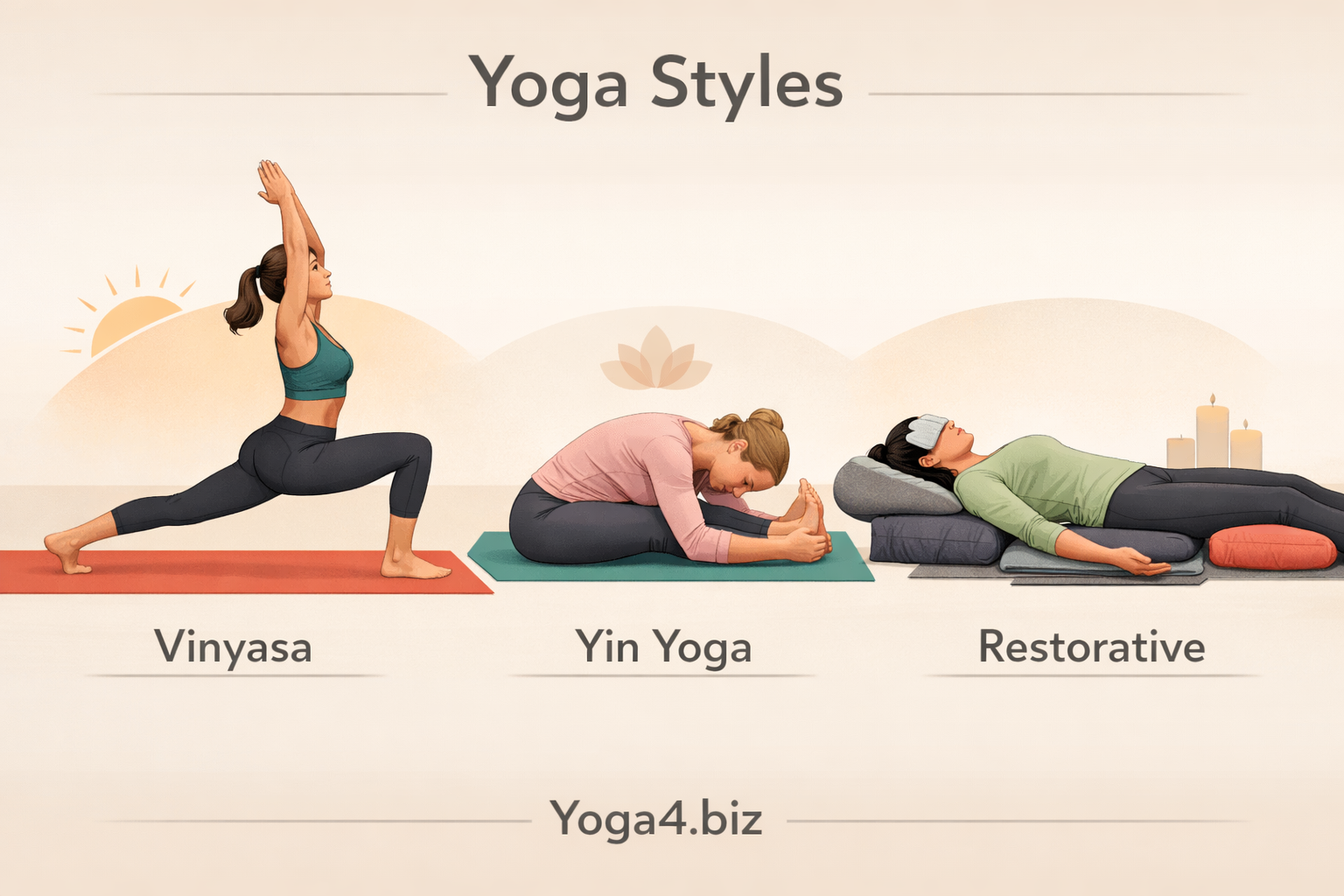
The best yoga style for you is the one that aligns with your primary goal. Choose Vinyasa or Power Yoga if you want cardio and strength. Choose Yin or Restorative Yoga if you need deep stretching and stress relief. Choose Hatha Yoga if you’re a complete beginner who wants to learn fundamentals at a manageable pace. Yoga4.biz breaks down each option with beginner-friendly explanations so you can start practicing today.
What Exactly Is a Yoga Style, and Why Does It Matter?
A yoga style is a specific approach to practicing yoga, defined by its pace, posture selection, breathing techniques, and overall philosophy. It matters because choosing the wrong one leads to frustration, while choosing the right one can genuinely change how your body feels and how your mind handles stress.
Think of it like exercise categories. “Working out” could mean running, weightlifting, swimming, or dancing. Each one trains your body differently. Yoga works the same way. Ashtanga follows a strict sequence of poses performed at a fast pace. Restorative uses props to hold you in passive positions for minutes at a time. Both are yoga. They produce very different results.
Here’s a quick framework:
- Want to sweat? Vinyasa, Power Yoga, Ashtanga, or Bikram
- Want to stretch deeply? Yin Yoga
- Want to relax? Restorative Yoga or Yoga Nidra
- Want to learn the basics? Hatha Yoga
- Want spiritual depth? Kundalini or Jivamukti
Understanding this distinction is the first step. The Yoga4.biz blog goes deeper into each category with practical guidance for beginners.
Which Yoga Style Is Best for Beginners?
Hatha Yoga is the best starting point for most beginners because it moves slowly enough to learn proper alignment, covers foundational poses, and includes breathing exercises without overwhelming you.
Why Hatha works for new practitioners
Hatha classes typically hold each pose for several breaths before moving to the next one. This gives you time to adjust your body, ask questions (in a live class), and build awareness of how each position should feel. Most Hatha classes run 60 minutes and include a mix of standing poses, seated stretches, and a final relaxation.
When Hatha might not be the right fit
If you already have a strong fitness background and find slow movement boring, Hatha may feel too easy. In that case, start with a beginner-level Vinyasa class instead. Vinyasa links breath to movement in a continuous flow, which keeps your heart rate up and your mind engaged.
Common beginner mistake: Jumping straight into an advanced Vinyasa or Ashtanga class. These styles assume you already know foundational poses like Downward Dog, Warrior I, and Chaturanga. Without that base, you risk injury or discouragement.
For a broader look at how yoga benefits your body and mind from day one, check out this guide on how yoga transforms your health.
How Do the Most Popular Yoga Styles Compare?
Below is a side-by-side comparison of the eight most widely practiced yoga styles in 2026. Use this table to narrow your options before trying a class.
| Yoga Style | Pace | Primary Benefit | Difficulty | Best For |
|---|---|---|---|---|
| Hatha | Slow | Foundational learning | Beginner | New practitioners |
| Vinyasa | Moderate to fast | Cardio + flexibility | Beginner to intermediate | People who like movement |
| Ashtanga | Fast, structured | Strength + discipline | Intermediate to advanced | Disciplined athletes |
| Power Yoga | Fast | Full-body strength | Intermediate | Fitness-oriented practitioners |
| Bikram/Hot Yoga | Moderate (heated room) | Detox + flexibility | Intermediate | Heat-tolerant individuals |
| Yin | Very slow | Deep connective tissue stretch | Beginner-friendly | Desk workers, runners, recovery |
| Restorative | Very slow (prop-supported) | Stress relief + relaxation | All levels | Stressed or injured individuals |
| Kundalini | Variable | Energy + spiritual awareness | Beginner to intermediate | Spiritually curious practitioners |
How to read this table
Start with the “Best For” column. Find the description that matches you, then read across to understand what that yoga style involves. If two or three styles seem appealing, try one class of each. Most studios and online platforms offer introductory classes for every style.
What Yoga Style Builds the Most Strength?
Power Yoga and Ashtanga build the most functional strength because both styles require you to support your body weight through challenging pose sequences with minimal rest.
Power Yoga
Power Yoga is an Americanized version of Ashtanga that drops the rigid sequence in favor of creative, teacher-led flows. Expect lunges, planks, arm balances, and core work. A typical Power Yoga class burns more calories than a standard Hatha session and builds noticeable upper-body and core strength within a few weeks of consistent practice.
Choose Power Yoga if: You want a workout that doubles as a yoga practice, and you don’t care about spiritual or meditative elements.
Ashtanga
Ashtanga follows a fixed series of poses (there are six series total, though most practitioners spend years on the Primary Series alone). The structure means your body adapts progressively, and you can track measurable improvement over time.
Choose Ashtanga if: You thrive on routine, enjoy mastering specific skills, and want a physically demanding practice with clear benchmarks.
A note on injury prevention
Both styles carry a higher injury risk than gentler forms of yoga, especially for the wrists, shoulders, and lower back. Warm up properly, don’t skip modifications, and listen to your body when something feels wrong — not just uncomfortable, but wrong.
What Yoga Style Is Best for Flexibility and Deep Stretching?
Yin Yoga is the most effective yoga style for improving flexibility because it targets connective tissues (fascia, ligaments, joints) through long-held passive stretches, typically 3 to 5 minutes per pose.
How Yin Yoga works
Unlike active styles where muscles do the work, Yin asks you to relax your muscles and let gravity pull you deeper into each position. This sustained stress on connective tissue stimulates remodeling and increased range of motion over time. It’s especially effective for hips, hamstrings, and the lower back.
Who benefits most from Yin
- Runners and cyclists with tight hips and IT bands
- Desk workers with stiff shoulders and compressed spines
- Athletes who need recovery-day stretching
- Anyone over 40 experiencing age-related stiffness
Common mistake with Yin: Pushing too hard, too fast. Yin is not about achieving the deepest version of a pose on day one. You should feel a moderate stretch — a 4 or 5 out of 10 intensity — and let time do the rest.
What Yoga Style Is Best for Stress Relief and Relaxation?
Restorative Yoga and Yoga Nidra are the most effective styles for stress relief because they activate the parasympathetic nervous system (your body’s “rest and digest” mode) through supported, passive postures held for extended periods.
Restorative Yoga
In a Restorative class, you’ll use bolsters, blankets, blocks, and straps to hold your body in comfortable positions for 5 to 20 minutes each. A full class might include only four or five poses. The goal isn’t stretching — it’s complete physical and mental relaxation.
Choose Restorative Yoga if: You’re dealing with chronic stress, burnout, insomnia, or recovering from illness or injury.
Yoga Nidra
Yoga Nidra (sometimes called “yogic sleep”) is a guided meditation done lying down. A facilitator walks you through body awareness, breath awareness, and visualization while you remain still. Sessions typically last 20 to 45 minutes. Many community wellness programs, including those offered through local recreation departments [1], incorporate yoga-based relaxation practices as part of broader health initiatives.
Choose Yoga Nidra if: You struggle with traditional seated meditation but want similar benefits.
Both practices pair well with more active yoga styles. Many experienced practitioners combine Vinyasa or Power Yoga on active days with Restorative or Nidra on rest days.
Can Yoga Replace a Gym Workout?
For some people, yes — particularly if your goals center on functional strength, flexibility, and body-weight fitness. Yoga won’t replace heavy barbell training for building maximum muscle mass, but vigorous styles like Power Yoga and Ashtanga provide a legitimate full-body workout.
What yoga can do
- Build and maintain functional strength (especially core, shoulders, and legs)
- Improve balance, coordination, and proprioception
- Increase cardiovascular endurance (in flow-based styles)
- Enhance flexibility and joint health
- Reduce stress hormones
What yoga can’t easily replace
- Heavy resistance training for muscle hypertrophy
- Sprint or high-intensity interval training (HIIT) for peak cardiovascular conditioning
- Sport-specific training (e.g., for competitive athletes)
Decision rule: If you’re happy with a lean, functional physique and don’t need to lift heavy weights, a combination of Vinyasa and Yin Yoga four to five times per week can serve as your primary fitness routine. If you want significant muscle gain, use yoga as a complement to weight training, not a replacement.
Organizations like Yoga4Change [2] demonstrate how yoga can serve as a standalone physical and mental health intervention in community settings, suggesting that for many populations, yoga provides sufficient exercise stimulus when practiced consistently.
How Do You Choose the Right Yoga Style for Your Goals?
Start by identifying your single most important goal, then match it to a style using the decision framework below.
Step-by-step selection process
- Define your primary goal. Write down the one thing you most want from yoga: strength, flexibility, stress relief, weight management, spiritual growth, or injury recovery.
- Assess your current fitness level. Be honest. If you can’t touch your toes or hold a plank for 30 seconds, start with beginner-appropriate styles.
- Consider your schedule. Ashtanga’s Primary Series takes 90 minutes. A Yin session can be done in 30. Factor in realistic time availability.
- Try before you commit. Take at least two classes in your chosen style before deciding. One class isn’t enough — you might have had a bad teacher or an off day.
- Reassess after 30 days. Your needs will evolve. A style that’s perfect now might not serve you six months from now.
Goal-to-style matching
- “I want to lose weight” → Vinyasa or Power Yoga (calorie burn + muscle engagement)
- “I want to reduce anxiety” → Restorative Yoga or Yoga Nidra (nervous system regulation)
- “I want to get more flexible” → Yin Yoga (connective tissue remodeling)
- “I want a structured practice” → Ashtanga (fixed sequence, clear progression)
- “I want spiritual exploration” → Kundalini (breathwork, chanting, energy work)
- “I want a bit of everything” → Hatha (balanced, foundational)
Visit the Yoga4.biz about page to learn more about the site’s approach to helping you find your fit.
What Are the Most Common Mistakes When Picking a Yoga Style?
The biggest mistake is choosing based on trends or peer pressure instead of personal goals and physical readiness. Here are the most frequent errors and how to avoid them.
Mistake 1: Starting too advanced
Jumping into a Level 2 Vinyasa class or a 90-minute Ashtanga session without foundational knowledge is a recipe for injury. Start at the beginner level even if you’re fit from other activities. Yoga uses muscles and movement patterns that running, cycling, and weightlifting don’t prepare you for.
Mistake 2: Assuming all yoga is gentle
Some people dismiss yoga as “just stretching.” Then they try a Power Yoga class and can’t walk the next day. Respect the range of intensity across styles.
Mistake 3: Ignoring the teacher factor
A great teacher can make any style enjoyable. A bad teacher can ruin even the best style. If you dislike your first class, try a different instructor before writing off the entire style.
Mistake 4: Never branching out
Many practitioners find one style they like and never explore others. Cross-training across styles — for example, combining Vinyasa for strength with Yin for flexibility — produces better overall results than sticking to one approach indefinitely.
Mistake 5: Comparing yourself to others
Yoga is individual practice. The person on the mat next to you might have 10 years of experience or a naturally flexible body. Focus on your own progress.
If you have questions about getting started or want personalized recommendations, the Yoga4.biz contact page is a good place to reach out.
How Often Should You Practice Yoga?
Two to three sessions per week are enough to achieve meaningful improvements in strength, flexibility, and stress levels within 4 to 6 weeks. Daily practice accelerates results, but it isn’t necessary for most people.
Frequency guidelines by style
| Yoga Style | Recommended Frequency | Why |
|---|---|---|
| Hatha | 2-4x per week | Gentle enough for frequent practice |
| Vinyasa | 3-5x per week | Moderate intensity allows regular sessions |
| Ashtanga | 5-6x per week (traditional) | Designed for near-daily practice with rest on moon days |
| Power Yoga | 2-4x per week | Higher intensity requires recovery days |
| Yin | 2-3x per week | Connective tissue needs time to adapt |
| Restorative | 1-3x per week (or daily) | No physical stress; can be done anytime |
The minimum effective dose
If you can only practice once a week, make it count: choose a 60-minute class in a style that addresses your primary goal. Once-a-week yoga won’t produce dramatic physical changes, but it will maintain baseline flexibility and provide consistent stress relief.
Can You Practice Multiple Yoga Styles?
Absolutely — and most experienced practitioners do. Combining styles is one of the smartest approaches to a well-rounded yoga practice.
Effective combinations
- Vinyasa + Yin: Active flow days for strength and cardio, Yin days for recovery and deep stretching.
- Ashtanga + Restorative: Disciplined, intense practice balanced with complete relaxation.
- Power Yoga + Yoga Nidra: Physical challenge paired with mental restoration.
- Hatha + Kundalini: Foundational movement combined with breathwork and energy practices.
How to structure a mixed-style week
Here’s an example schedule for someone practicing five days a week:
- Monday: Vinyasa (60 min)
- Tuesday: Yin (45 min)
- Wednesday: Power Yoga (60 min)
- Thursday: Rest or gentle walk
- Friday: Vinyasa (60 min)
- Saturday: Restorative (45 min)
- Sunday: Rest
This kind of variety keeps your body challenged, prevents overuse injuries, and keeps your practice mentally fresh. The Yoga4.biz blog regularly publishes scheduling tips and style-pairing recommendations.
Where Can You Practice Yoga in 2026?
You can practice yoga at home, in studios, at gyms, outdoors, or through online platforms. The best setting depends on your budget, learning style, and schedule.
At home (online classes)
The most accessible option. Platforms like YouTube offer free classes in every yoga style [3]. Paid subscriptions on dedicated yoga platforms typically run $10 to $25 per month and offer structured programs, progress tracking, and higher production quality.
Choose home practice if: You have limited time, prefer privacy, or live far from a studio.
In a studio
Studios provide hands-on adjustments, community, and accountability. Class prices vary widely — expect $15 to $30 per drop-in class, or $100 to $200 per month for unlimited memberships in most U.S. cities.
Choose studio practice if: You learn better with in-person instruction and enjoy a group environment.
At a gym
Most gyms include basic yoga classes (usually Hatha or Vinyasa) in their membership. Quality varies significantly. Gym yoga is a good starting point, but often lacks the depth of a dedicated studio.
Outdoors and community settings
Parks, beaches, and community centers increasingly offer yoga classes, sometimes free of charge. Local government recreation programs [1] frequently include yoga as part of their wellness offerings, making it an affordable entry point for beginners.
FAQ
What is the easiest yoga style for someone who has never exercised?
Restorative Yoga is the easiest because it requires no strength or flexibility — you lie in supported positions and breathe. Hatha is the easiest active style, with slow movements and clear instructions.
Can I do yoga if I’m not flexible?
Yes. Flexibility is a result of yoga, not a prerequisite. Every pose can be modified with props (blocks, straps, blankets) to accommodate any body.
How long does it take to see results from yoga?
Most people notice improved mood and reduced tension after their first week. Physical changes like increased flexibility and strength typically become noticeable within four to six weeks of practicing two to three times per week.
Is hot yoga safe?
For most healthy adults, yes. However, people with heart conditions, low blood pressure, or heat sensitivity should consult a doctor first. Always hydrate before, during, and after hot yoga classes.
What equipment do I need to start yoga?
A yoga mat is the only essential item. Blocks, straps, and bolsters are helpful but not required — you can substitute household items (books for blocks, a belt for a strap, pillows for bolsters).
Can yoga help with back pain?
Many practitioners report significant back pain relief from yoga, particularly from styles that emphasize gentle stretching and core strengthening like Hatha and Yin. However, if you have a diagnosed spinal condition, consult a healthcare provider before starting.
What’s the difference between Vinyasa and Hatha?
Hatha holds individual poses for several breaths with pauses between them. Vinyasa links poses together in a continuous, breath-synchronized flow. Vinyasa is generally faster and more physically demanding.
Is Kundalini Yoga religious?
Kundalini incorporates chanting, mantra, and spiritual concepts rooted in Sikh and Hindu traditions, but it’s practiced by people of all backgrounds and beliefs. You don’t need to adopt any religious framework to benefit from it.
How do I know if a yoga teacher is qualified?
Look for a Yoga Alliance RYT-200 or RYT-500 certification at a minimum. These designations mean the teacher completed 200 or 500 hours of accredited training. Experience and teaching style matter too — certifications are a baseline, not a guarantee of quality.
Can children practice yoga?
Yes. Yoga is widely taught to children as young as three, with age-appropriate modifications. Programs like Yoga4Change [2] have demonstrated yoga’s effectiveness across diverse populations, including youth.
Key Takeaways
- A yoga style is a specific approach to practice defined by pace, pose selection, and philosophy — choosing the right one is the most important decision a new practitioner makes.
- Hatha Yoga is the best entry point for most beginners because it teaches fundamentals at a manageable pace.
- Vinyasa and Power Yoga are the strongest options for people seeking a physical workout from their yoga practice.
- Yin Yoga is the most effective style for improving flexibility and targeting connective tissue.
- Restorative Yoga and Yoga Nidra are the best choices for stress relief, anxiety reduction, and nervous system recovery.
- Combining multiple yoga styles produces better overall results than practicing only one.
- Two to three sessions per week is the minimum frequency for noticeable physical and mental benefits.
- The best yoga style is the one you’ll actually do consistently — enjoyment and sustainability matter more than any specific technique.
- Yoga4.biz exists to simplify this decision with clear, beginner-friendly guidance for every style.
- Start exploring today at Yoga4.biz and find the practice that fits your life.
Conclusion
Choosing a yoga style doesn’t need to be complicated. Start with your goal — strength, flexibility, relaxation, or something else — and match it to the style that serves that goal best. If you’re brand new, begin with Hatha or a beginner Vinyasa class. If you’ve been practicing and want to expand, experiment with Yin, Kundalini, or Restorative to round out your routine.
The most important step is the first one. Roll out a mat, press play on a video, or walk into a class. Give yourself permission to be a beginner. And if you’re not sure where to start, Yoga4.biz is built specifically to guide you through that decision, one yoga style at a time.
Your next steps:
- Review the comparison table above and identify one or two styles that match your goals.
- Try a free beginner class online or at a local studio this week.
- Practice consistently for 30 days before evaluating whether the style is right for you.
- Bookmark Yoga4.biz for ongoing style guides, tips, and beginner resources.
References
[1] Oak Island, NC Community News – https://www.oakislandnc.gov/Home/Components/News/News/2367/16
[2] Yoga4Change (Y4C) – https://www.y4c.org
[3] YouTube Yoga Resources – https://www.youtube.com/watch?v=qOGTp6sPaL4